The Charismatic Leader: Why the Masses Follow, How Power Corrupts, and How Leaders Fall
Throughout history, societies have repeatedly produced leaders who possess an extraordinary ability to attract, persuade and mobilize large numbers of people. Some become national heroes and democratic statesmen; others become populists, authoritarians or dictators. The striking feature is that many of them do not rise to power by force alone. They are sometimes chosen by the very people who later suffer under their rule.
This raises an important question: What makes an ordinary politician charismatic enough to become a leader of the masses? Why do educated and uneducated people alike vote for such leaders? And why can a leader who begins with promises of national renewal eventually become narcissistic, ruthless, power-hungry and intolerant of opposition?
What makes a leader charismatic?
Charisma is not simply intelligence or education. It is the ability to create an emotional connection with people and make them feel that the leader understands their problems, represents their aspirations and can rescue them from their difficulties.
A charismatic leader often possesses several characteristics:
- A powerful and confident speaking style.
- The ability to simplify complicated problems into easily understood messages.
- Strong personal presence and emotional appeal.
- The ability to identify an enemy or group supposedly responsible for people’s problems.
- Nationalistic or religious symbolism.
- A promise to restore lost greatness.
- An image of being an outsider who is fighting an established political establishment.
- The ability to communicate directly with ordinary people.
- A willingness to say what many people privately think but hesitate to say publicly.
Populist politics frequently involves an emotionally charged relationship between a personalistic leader and his followers. Juan Domingo Perón in Argentina is a classic example: he built support among workers by promising higher wages, pensions, social benefits and national strength. (Encyclopedia.com)
Charisma, therefore, is not necessarily a measure of a leader’s moral character. A person can be highly charismatic and simultaneously be deeply destructive.
Are charismatic leaders educated or uneducated?
They can be either. Education is not the determining factor.
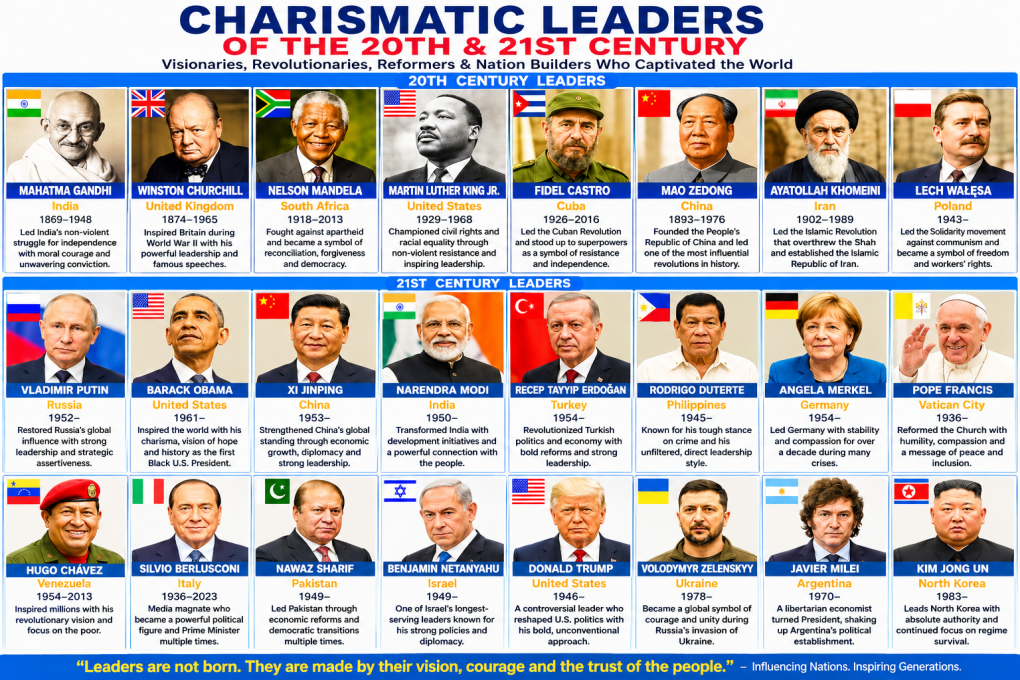
Mahatma Gandhi was highly educated as a lawyer. Winston Churchill was highly educated and intellectually accomplished. Nelson Mandela studied law. Jawaharlal Nehru was educated at Harrow and Cambridge. Barack Obama graduated from Harvard Law School.
At the other extreme, some highly influential leaders came from relatively modest educational backgrounds. Benito Mussolini did not receive a university education. Joseph Stalin attended a theological seminary but did not complete his studies. Adolf Hitler did not attend university. Their influence came not from academic qualifications but from their ability to exploit political circumstances, communicate emotionally and mobilize followers.
This demonstrates an important truth:
Education can give a leader knowledge, but it does not automatically give him wisdom, morality or humility. Conversely, lack of formal education does not prevent someone from possessing extraordinary political intelligence.
The same principle applies to voters. Educated people are not automatically immune to political manipulation, while uneducated people are not incapable of making rational political judgments.
Why do the masses love and follow charismatic leaders?
People rarely vote purely on the basis of policy documents. Voting is also an emotional act.
A citizen may vote for a leader because he represents:
Hope.
The leader promises a better future.
Security.
People frightened by crime, war, terrorism, economic collapse or social instability may prefer a strong leader.
Identity.
The leader makes people feel proud of their religion, ethnicity, nationality, class or cultural traditions.
Revenge against the establishment.
People who believe that elites, politicians or wealthy groups have ignored them may support someone who promises to destroy the existing political order.
Economic benefit.
Wages, pensions, subsidies, employment, housing and welfare programs can create genuine loyalty.
National pride.
A leader who promises to make the country “great,” respected or powerful can generate enormous emotional support.
Personal identification.
Followers may see the leader as “one of us”—someone who speaks their language, shares their frustrations and expresses their anger.
Perón illustrates this phenomenon particularly well. His government expanded workers’ rights and social benefits, while Eva Perón became a powerful symbol of compassion toward the poor. Their political movement therefore developed an intensely personal relationship with working-class Argentina. (Encyclopedia.com)
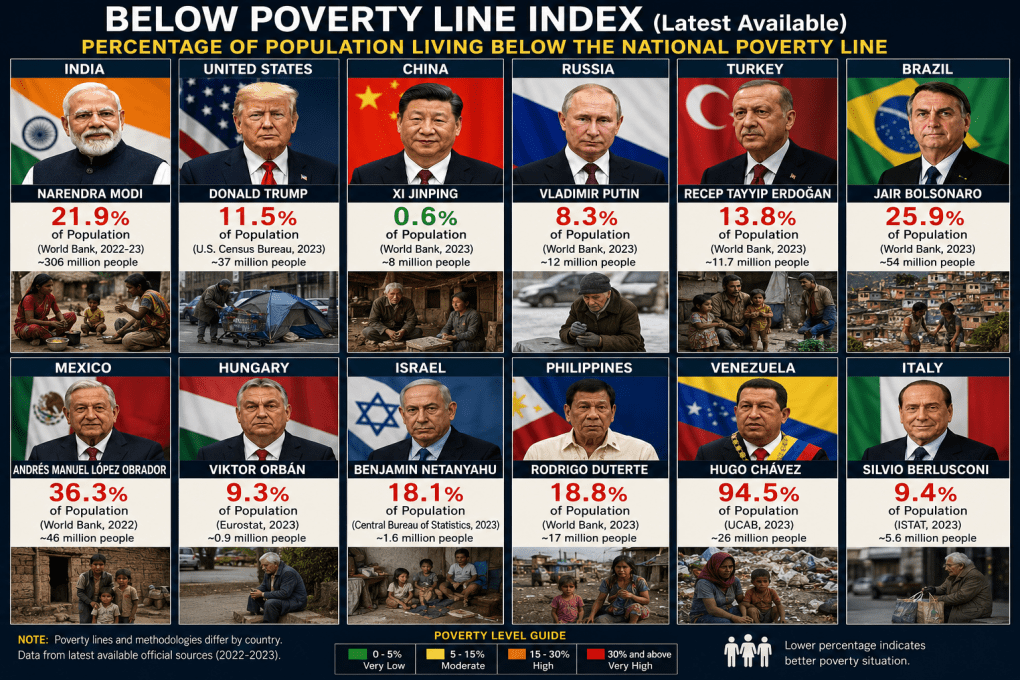
Hugo Chávez similarly built enormous support among Venezuela’s poorer population by promising to combat corruption, reduce poverty, strengthen national sovereignty and expand social programs. He won presidential elections with substantial majorities. (Encyclopedia.com)
Why do people continue supporting leaders who behave badly?
This is one of the most troubling questions in democratic politics.
Once people emotionally identify with a leader, criticism of the leader can begin to feel like an attack on the people themselves.
A psychological transformation can occur:
“I support this leader” becomes
“This leader represents me”, which eventually becomes
“An attack on the leader is an attack on me and my country.”
At that stage, facts may become less important than loyalty.
Supporters may forgive corruption because they believe the leader is fighting their enemies. They may excuse lies because they believe the leader is defending the nation. They may tolerate attacks on institutions because they believe those institutions are controlled by the opposition.
This is where charismatic leadership can become dangerous.
Does power make charismatic leaders narcissistic and ruthless?
Power does not inevitably corrupt every leader. But unchecked power creates conditions in which corruption of character and institutions becomes increasingly likely.
A leader who initially believes, “I need power to serve the people,” can gradually begin believing, “I am the only person capable of serving the people.”
The distinction is enormous.
The first attitude accepts democracy.
The second begins to destroy it.
Such leaders may gradually develop several dangerous characteristics:
- Excessive self-confidence.
- Narcissism and an exaggerated sense of personal importance.
- Intolerance of criticism.
- Suspicion of opponents.
- Concentration of power.
- Manipulation of the media.
- Attacks on independent institutions.
- Cultivation of personal loyalty.
- Appointment of friends and loyalists rather than competent officials.
- Political propaganda.
- Blaming minorities, foreigners or opponents for national problems.
- Refusal to acknowledge mistakes.
- Changing laws or constitutional arrangements to remain in power.
- Treating political opponents as enemies of the nation.
The most extreme historical examples include Adolf Hitler, Benito Mussolini and Joseph Stalin. Their regimes demonstrate what happens when mass political mobilization is combined with the destruction of institutional restraints. Mussolini gradually transformed parliament into an impotent institution and eventually abolished it. (Encyclopedia.com)
Hitler went still further, transforming Germany into a totalitarian dictatorship and ultimately leading the country into catastrophic war and genocide.
Stalin developed an enormous cult of personality and ruled through repression, purges and fear.
These examples should not be used to suggest that every charismatic or populist politician becomes a Hitler or Stalin. The historical circumstances and political systems were very different. The lesson is instead that personality-centered politics becomes dangerous when constitutional institutions can no longer restrain the leader.
The democratic paradox
Democracy contains a paradox.
The people have the right to choose their leaders. But the majority can sometimes choose a leader who subsequently attempts to weaken the very democratic institutions that allowed him to acquire power.
History has repeatedly demonstrated this danger.
The rise of Mussolini is an important example. He entered government through the constitutional political system but progressively dismantled parliamentary democracy. (Encyclopedia.com)
This does not mean that democracy itself is defective. Rather, democracy requires more than elections.
A healthy democracy requires:
free elections + independent courts + free media + constitutional limits + opposition parties + an independent legislature + peaceful transfer of power + respect for political minorities.
An election gives a leader authority. It does not give him unlimited authority.
Do charismatic leaders care about the people who elected them?
Some genuinely do.
Leaders such as Nelson Mandela demonstrated that extraordinary popularity could be combined with restraint, reconciliation and respect for democratic institutions.
Others implement meaningful policies while simultaneously weakening institutions. Perón, for example, achieved substantial improvements for sections of the working class while also exercising strong control over political and social organizations. (Encyclopedia.com)
Still others eventually become more interested in preserving their own power than improving the lives of their citizens.
This creates the crucial test of leadership:
Does the leader regard himself as the servant of the nation, or does he gradually begin to regard the nation as an instrument for his own power?
A genuine statesman can leave office.
A power-hungry leader cannot imagine life without office.
The warning signs of a leader’s downfall
The decline of a charismatic leader usually begins long before his actual removal from power.
Several warning signs are particularly important.
1. Economic deterioration
When unemployment rises, inflation accelerates, public debt becomes unsustainable or living standards decline, the leader’s popularity may weaken.
2. Corruption becomes visible
A leader may initially campaign against corruption but eventually become surrounded by wealthy associates, family members and political loyalists.
3. Internal divisions appear
The political coalition that brought the leader to power begins to fracture.
4. The leader becomes increasingly isolated
Leaders who surround themselves only with people who agree with them eventually lose contact with reality.
5. Propaganda replaces achievement
When governments cannot demonstrate results, they may increasingly rely on slogans, propaganda and attacks against opponents.
6. Repression increases
The use of police, courts or security agencies against political opponents is often a sign that voluntary public support is weakening.
7. Former supporters become critics
When respected intellectuals, business leaders, journalists, military officers or members of the leader’s own political organization begin criticizing him, the political foundation may be cracking.
8. Elections become threatening
A particularly important warning sign occurs when a leader begins manipulating electoral rules, attacking election authorities or refusing to accept unfavorable results.
9. The leader creates an enemy
A declining leader may attempt to redirect public anger toward foreigners, minorities, opposition parties or imaginary conspiracies.
10. Fear replaces admiration
The strongest warning sign is when people who once followed the leader enthusiastically begin obeying him because they are afraid rather than because they believe in him.
How do such leaders ultimately fall?
There is no single pattern.
Some lose elections.
Some are removed by their own political parties.
Some are overthrown by the military.
Some resign after mass protests.
Some die in office.
Some are imprisoned.
Some flee the country.
Some are executed after being overthrown.
Mussolini was captured and executed by Italian partisans in 1945. Hitler died by suicide as Nazi Germany collapsed. Stalin died in office in 1953.
Perón was removed from power by a military coup in 1955, after economic deterioration and growing political conflict. (Encyclopedia.com)
Other charismatic leaders survive politically because their movements become larger than their individual personalities. Peronism, for example, continued to shape Argentine politics long after Perón himself had disappeared from the political scene. (Encyclopedia.com)
This reveals another important characteristic of charismatic politics: sometimes the leader dies, but the political movement survives.
The difference between a charismatic leader and a great leader
Charisma should never be confused with greatness.
A charismatic leader asks:
“How many people will follow me?”
A democratic statesman asks:
“How strong will the country be when I am gone?”
The first seeks followers.
The second builds institutions.
The first wants loyalty.
The second wants capable successors.
The first may demand applause.
The second accepts criticism.
The first treats opposition as betrayal.
The second recognizes opposition as a necessary part of democracy.
The first wants his name remembered.
The second wants his institutions to survive.
This is perhaps the most important distinction of all.
Conclusion
History demonstrates that charismatic leadership is neither inherently good nor inherently bad. Charisma is simply a powerful political instrument. It can be used by leaders such as Gandhi, Mandela and other democratic statesmen to inspire sacrifice, reform and national unity. It can also be exploited by leaders such as Hitler, Mussolini and other authoritarian rulers to mobilize hatred, destroy institutions and concentrate power.
The education of the leader or voter alone does not determine the outcome. What matters is the strength of democratic institutions, the quality of civic education, the independence of the media, the rule of law and the willingness of citizens to question leaders—even leaders whom they admire.
The greatest danger begins when citizens stop saying:
“I support my leader because I believe his policies are good,”
and start saying:
“My leader is always right.”
At that moment, democracy begins to change from government by the people into government through the personality of one individual.
The ultimate safeguard is therefore not simply choosing a good leader. It is building a political system in which even a bad leader cannot easily destroy the country.
A truly great democratic leader should therefore leave behind not a population that worships him, but a nation strong enough to function without him